对氯硝基苯的加氢工艺研究
来源:56doc.com 资料编号:5D30053 资料等级:★★★★★ %E8%B5%84%E6%96%99%E7%BC%96%E5%8F%B7%EF%BC%9A5D30053
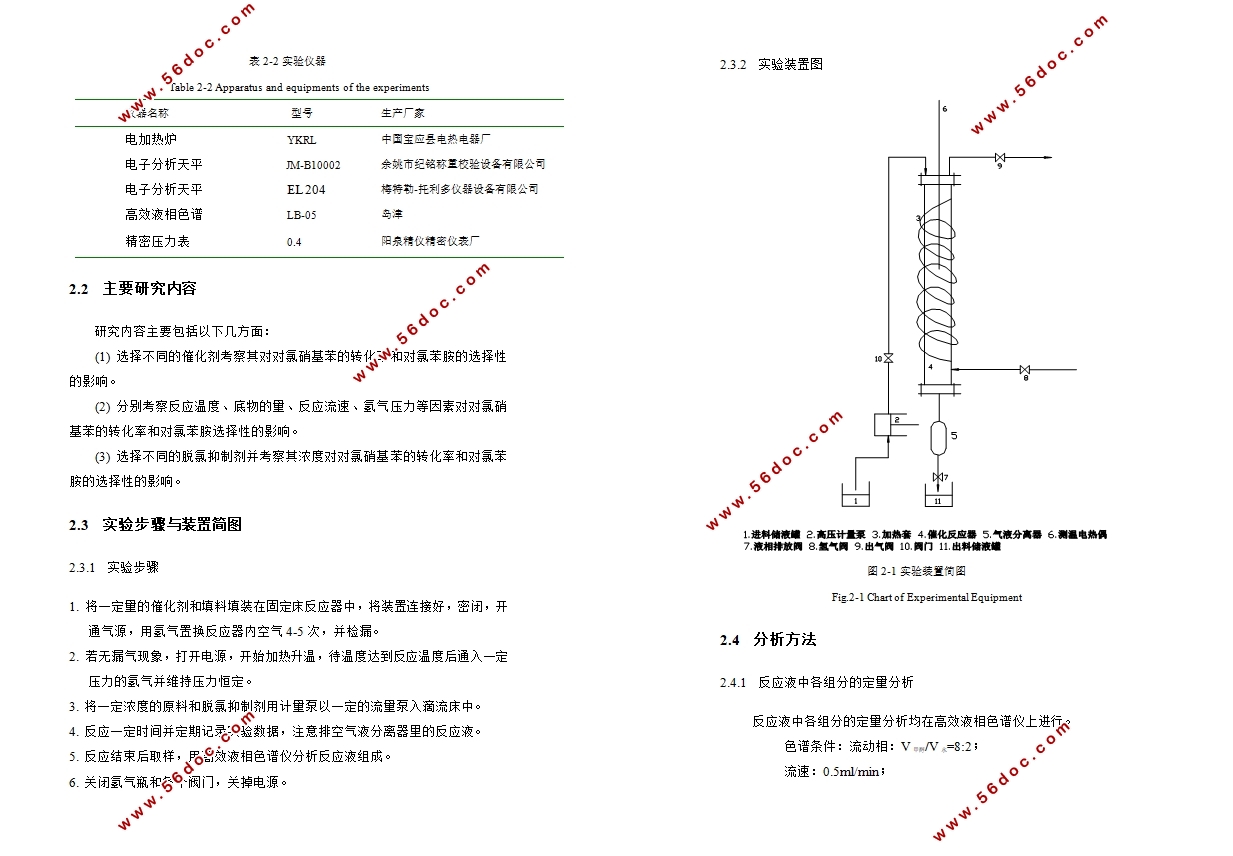
资料以网页介绍的为准,下载后不会有水印.资料仅供学习参考之用. 密 保 惠 帮助
资料介绍
对氯硝基苯的加氢工艺研究(任务书,开题报告,外文翻译,论文8000字)
摘要
通过单因素实验法考察了各因素对p-氯硝基苯加氢工艺条件的影响,包括:底物的量、氢气压力、反应温度、料液流速以及脱氯抑制剂的种类和浓度等因素。研究结果表明,p-氯硝基苯催化加氢的最佳工艺条件:反应温度70℃,氢气压力为1MPa,流速1mL/min,以0.15mol/L吗啡啉为抑制剂,还原浓度为20g/L对氯硝基苯乙醇溶液时加氢效果最优,对氯硝基苯的转化率为98.57%,对氯苯胺的选择性为95.11%。
关键词:对氯硝基苯 催化加氢 对氯苯胺 脱氯抑制剂
Study on the hydrogenation process of chloronitrobenzene
Abstract
Various factors on the conditions of p-chloronitrobenzene’s hydrogenation process were investigated by single factor test method, including the amount of substrate, hydrogen pressure, reaction temperature, fluid rate, the type and concentration of dechlorination inhibitors and other factors. The results showed that p-chloronitrobenzene hydrogenation’s optimum conditions are that the temperature was 70℃, hydrogen pressure was 1MPa, and the flow rate was 1mL/min with 0.15mol/L morpholine as inhibitors. It was optimal to reduce 20g/L ethanol solution of p-chloronitrobenzene when the Chloronitrobenzene’s conversion rate was 98.57% as well as the selectivity of p-chloroaniline 95.11%.
Key Words: P-chloronitrobenzene; Catalytic hydrogenation; P-chloroaniline; Dechlorination inhibitors
目 录
摘要 I
Abstract II
目录 1
第一章 文献综述 1
1.1 前言 1
1.2 对氯苯胺的合成方法 1
1.2.1 铁粉还原法 1
1.2.2 硫化碱还原法 2
1.2.3 肼还原法 2
1.2.4 催化加氢还原法 3
1.3 加氢催化剂 4
1.3.1 贵金属催化剂 4
1.3.2 镍基催化剂[8] 4
1.3.3 非晶态合金催化剂 4
1.3.4 纳米镍金属催化剂 5
1.4 抑制脱氯研究进展 5
1.5 本课题研究的目的和意义 6
第二章 实验材料与方法 7
2.1材料与仪器 7
2.1.1实验材料 7
2.1.2实验试剂 7
2.1.3实验仪器 7
2.2主要研究内容 8
2.3实验步骤与装置简图 8
2.3.1实验步骤 8
2.3.2实验装置图 9
2.4分析方法 10
2.4.1反应液中各组分的定量分析 10
2.4.2计算公式 10
第三章 实验结果与讨论 11
3.1 氢气分压对XP-CNB及SP-CAN的影响 11
3.2 反应温度对XP-CNB及SP-CAN的影响 12
3.3 底物浓度对XP-CNB及SP-CAN的影响 13
3.4 料液流速对XP-CNB及SP-CAN的影响 13
3.5 脱氯抑制剂的选择对XP-CNB及SP-CAN的影响 14
3.6 吗啉用量对XP-CNB及SP-CAN的影响 15
第四章 结论与展望 17
4.1 结论 17
4.2 展望 17
参考文献 18
致 谢 20
|